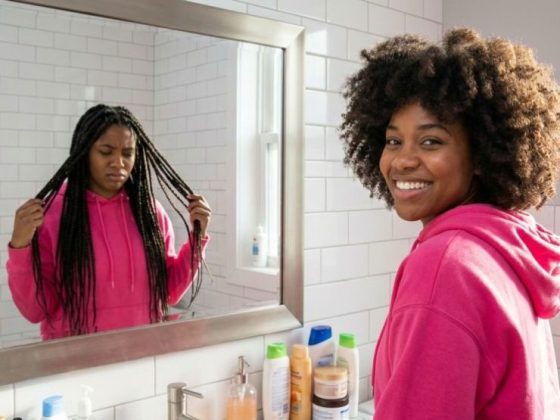
The psychology of “choice” for many American black women and their preference for wearing synthetic hair is often deeply rooted in “sisterhood” as a communal identity and a shared economic survival.
Here is an assessment of the psychological and emotional health costs of this unnatural behavior “choice.”
Cultural Identity and diaspora “Anchoring.” 🌍
For many American black women, the cultural act of hair braiding is a psychological “anchor.”
• Ancestrally: hair braiding is not just a trend; it is a traceable 5,000-year-old practice, all the way back to ancient Kemet (Egypt). Wearing braids naturally provides a sense of cultural aesthetics for many Black women, which tends to act as a buffer against societal marginalization.
• The Ritual of Hair-braiding: The day-long process of weaving box braids into black women’s own natural hair has often become a communal ritual, for the sake of “sisterhood”. Whether in a salon or a living room, this “braiding time” serves as a space for storytelling and emotional processing, fostering a sense of belonging and community.
The “Strong Black Woman” helmet 🪖
Psychologically, synthetic braids function as a “helmet” for the mental load of daily financial life.
• Decision Fatigue: Maintaining her own natural hair in a society that often critiques it requires constant mental energy. Synthetic braids provide a “set it and forget it” solution that reduces daily anxiety about “Western world” hair presentation standards.
• Predictability as Peace: In periods of high stress (like living single or career transitions), the predictability of a synthetic style provides a sense of control, “my choice”. As Dr. Afiya Mbilishaka (a psychologist and hair historian) notes, synthetic braids allow women to “hold it together” when other areas of their lives feel chaotic.
The Synthetic Mental Health Conflict: “Ditch the Itch.” 🤬
Recently, a significant psychological shift has occurred due to new research on the unnatural toxicity of synthetic hair fibers.
• Physical Irritation = Mental Stress: The “itch” associated with synthetic hair isn’t just a nuisance; chronic scalp irritation can lead to sleep disruption and increased irritability, negatively impacting daily mental well-being.
• The Transition Anxiety: As awareness increases about the connection between synthetic hair and endocrine disruption, or even, more alarmingly, cancer, many women are developing a new form of health anxiety, prompting a psychological re-evaluation of this beloved cultural staple.
Professionalism and Code-Switching 💼
While box braids are a celebration of “Black-ness”, the choice to wear them is still sometimes a calculated move to navigate hair discrimination.
• Economic Survival: The CROWN Act has begun to protect natural styles, but the psychological pressure to look “neat” (as defined by Eurocentric standards) remains. Box braids are often seen as a “tidy” alternative to an Afro, allowing for a form of code-switching that feels more authentic than chemical straightening but “safer” than un-braided natural hair.
Emotional Health: The Burden of “Good Hair.” 💔
For many Black women, hair is tied to Self-Edification. When a woman cannot afford high-end human hair, she may turn to synthetics to avoid the “self-neglect” label often unfairly applied to unstyled Afro-textured hair in clinical or corporate settings. This “forced” acceptability can lead to:
• Scalp Trauma: Literal pain from heavy synthetic extensions that can lead to chronic headaches, sleep disruption, and direct negative impact on daily emotional health.
• Cognitive Dissonance: Knowing a product is “cheap” or potentially “toxic” but feeling it is the only way to look “presentable” for a job interview or an “upscale” encounter.
The Financial & Transactional Aesthetics 💹
The “transactional aesthetic” refers to the trade-off between upfront cost and social currency. Synthetic hair is the engine of the “fast fashion” hair industry.
• Cost Barrier vs. Frequency: Human hair bundles can cost between $200 and $2,000+, whereas synthetic packs often range from $5 to $50. For women who view hair as a rotating accessory—changing styles every 2–4 weeks—using synthetic hair offers a high-frequency “new look” at a fraction of the cost.
• The “Finished” Look: In many professional and social circles, the aesthetic “transaction” is about appearing “fixed.” Synthetic hair provides instant texture and style (pre-curled or pre-braided) that holds up in humidity, making it a reliable tool for maintaining a specific image, socially, without the volatility or the maintenance of her own natural human hair.
• Maintenance Paradox: While human hair lasts longer, it requires significant labor (washing, conditioning, styling). Synthetic hair is often “throwaway,” allowing a woman to buy time—a valuable commodity—at the expense of her own emotional health and psychological longevity.
Emerging Health Risks 🏥
Recent research has shifted from a purely psychological impact to neuro-psychological and fact-based physiological risks posed by synthetic hair fibers.
• Color Coding: Synthetic hair (often made of PVC or acrylic) is frequently coated in flame retardants and chemicals like lead-based paint and phthalates. These color chemicals are harmful to the body.
• The Toxic Load: Synthetic hair is unregulated and contains deep-layer skin disruptors, like lead, and carcinogens like benzene. Chemicals that can be absorbed through the scalp during periods of sweating.
• Endocrine Disruption & Mood: Endocrine disruptors interfere with the body’s hormonal system. Because hormones (like cortisol and estrogen) are deeply tied to mood regulation, chronic exposure through synthetic hair inflames unaddressed links to anxiety attacks and chronic irritability.
• The “Hair Stress” Paradox: There is a psychological burden that goes along with using a “protective style” that may actually be harmful. This creates a cycle of Internalized Conflict: the need to meet societal beauty standards vs. the physical discomfort (itching, rashes, or “braid balls”) and long-term emotional health associated with feeling dependent on synthetic hair to “feel better. “
At the end of the day…
While appearing to be a transactional heritage, economic strategy, and psychological show of resilience, synthetic box braids are also increasingly defined by a growing public health conversation regarding the materials used.
Notwithstanding the negative psychological and emotional health impact upon those same women who are becoming unnaturally reliant on “the feel” that comes along with “looking better.”
Synthetic options dominate the market due to their accessibility and the “transactional” nature of high-frequency styling.
Black women’s own hair will always be naturally positioned as the “Gold standard” of “Looking better” on her, as a Black woman
One response to “The Psychology of Black Women and Synthetic Hair”
-
kdovfgfkuvdlsrmonxsljwryqwuwnx

Leave a Reply